
Energy distribution is evolving rapidly. Companies that purchase oil and gas from refineries, store it in terminals, and then distribute to retail gas stations, commercial fleets, and government entities face increasing pressure to modernize operations. Traditional systems, often fragmented and reliant on spreadsheets or legacy CRMs, struggle to provide the transparency, scalability, and customer insight required to compete.
This is where Salesforce offerings prove transformative. Migrating their complex business processes to Salesforce enables energy firms to unify their sales operations, streamline processes, and deliver superior customer experiences across multiple channels.
Why Energy Firms will Benefit from Salesforce
Complex Sales Models Require Unified Systems
Energy distributors manage multiple customer types, including retailers such as gas stations that require regular, scheduled replenishments, commercial fleets like taxi firms using fleet cards, and government contracts covering fire departments, police vehicles, and school buses. Each of these segments involves unique pricing, contracts, compliance requirements, and payment terms. Salesforce centralizes all this data, ensuring sales teams no longer chase information across disconnected systems.
End-to-End Visibility Across the Value Chain
With Sales Cloud, account managers can track the journey from refinery purchase to terminal storage to customer delivery. This transparency ensures accurate forecasting, helps prevent supply shortages, and allows sales teams to identify upsell and cross-sell opportunities, such as offering fleet management solutions or loyalty programs to retail clients.
Enhanced Relationship Management
Salesforce provides a 360-degree view of every customer: retailers, fleet operators, and government accounts. Sales teams gain insight into historical purchases, contract terms, service issues, and renewal cycles to empower them to anticipate customer needs before they arise.
Smarter Sales Forecasting
Energy sales are highly cyclical and influenced by fuel prices, seasonal demand, and contract renewals. Salesforce’s AI-driven forecasting models give leadership real-time visibility into revenue trends and help optimize supply planning.
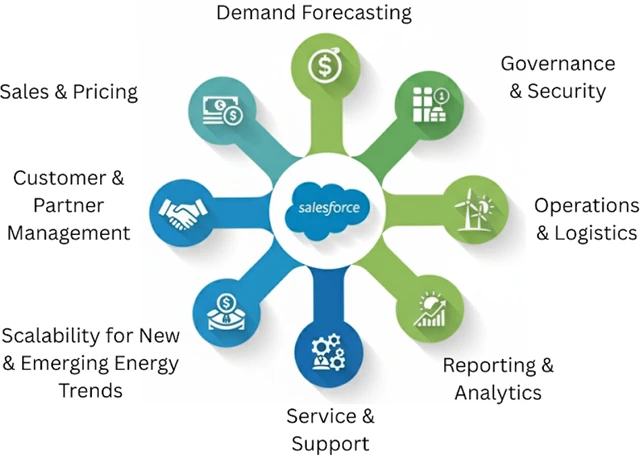
Salesforce Clouds Tailored for Energy Distribution
Sales Cloud & Revenue Cloud Advanced- Sales Cloud serves as the CRM backbone by helping teams manage account hierarchies, opportunity tracking, forecasting, and partner channels (e.g., brokers, resellers, carriers) to unify retailers, fleets, and government clients.
- Revenue Cloud Advanced (CPQ + billing + revenue intelligence) streamlines complex quote-to-cash cycles. It handles multi-site pricing, commodity/non-commodity bundles, fleet card contracts, and government procurement workflows seamlessly.
- Service Cloud equips teams with omnichannel support, field ticketing, case tracking, and self-service portals: all essential for managing deliveries, incident response, fuel quality inquiries, and fleet account servicing.
- Agentforce Assistant empowers agents with AI suggesting next best actions, accelerating approvals, and simplifying communications during high-stakes service or sales events.
- Optimize Fuel Delivery & Maintenance Schedules Automatically dispatch drivers and field technicians for fuel deliveries, terminal equipment servicing, or pipeline inspections, ensuring the right resource arrives with the right tools at the right time.
- Enhance Safety & Compliance – Digitize work orders and safety checklists for field crews, enabling real-time compliance tracking for hazardous materials handling, government contracts, and regulatory audits.
- Boost Customer & Partner Experience – Provide retailers, fleet operators, and government clients with accurate ETAs, proactive alerts, and digital proof of service, improving trust and satisfaction.
- Create branded customer portals for retail stations or government contacts to track deliveries, contracts, usage, billing, and place restocking orders.
- Build partner portals for logistics providers, terminal operators, or trucking firms—enabling pricing quotes, job assignments, service coordination, and better collaboration.
- Although often applied upstream, Manufacturing Cloud provides distributors a clear view of supply agreements (e.g., refinery contracts), volume forecasts, and pipeline scheduling. All these are crucial for storage capacity planning, terminal allocations, and optimizing logistics. It supports predictive maintenance and asset management for terminals too.
- Embedded CRM Analytics, underpinned by Einstein AI, enables demand forecasting, margin optimization for fleet and government tenders, contract-performance tracking, and anomaly detection during outages or price spikes. Intuitive dashboards ensure executives see opportunities and risks in real time.
- Energy & Utilities Cloud brings best-practice templates tailored for oil & gas (sales, service, order management, CPQ) reducing customization costs and accelerating deployment.
- It includes functionality like asset tracking, incident management, mobile field tools, and the energy-specific data model to bring clarity across terminals, trucks, and customer endpoints.
- Data Cloud centralizes siloed data from fleet usage, contracts, billing systems, and CIS to deliver unified visibility across business lines.
Key Benefits of Migrating to Salesforce
With Salesforce, energy distributors benefit from a streamlined lead-to-cash process that standardizes pricing models across retail, fleet, and government accounts, reducing errors and accelerating deal cycles. Compliance and audit readiness are improved as all interactions and contracts are tracked within the system, making records easily accessible for regulatory reviews.
The platform also supports an integrated partner ecosystem, extending visibility and collaboration to brokers, resellers, and transport companies through Partner Relationship Management tools.
Its mobile-first capabilities empower sales reps and field teams to access customer data and update records from terminals, on the road, or at client locations, ensuring timely service and reporting. Most importantly, Salesforce offers scalability for growth, supporting expansion into new territories, products, or services such as renewable fuels or EV charging infrastructure without the constraints of legacy systems.
Real-World Example: A Modern Energy Distributor
Consider an energy wholesaler supplying both retail gas stations and a government transit authority. Historically, the sales team managed fleet card contracts in one system, government bids in another, and retail deliveries through spreadsheets.
After migrating to Salesforce, the company unified all contracts and accounts into a single system of record, eliminating the inefficiencies of scattered data and disconnected tools. With AI-driven opportunity scoring, sales teams could now prioritize fleet renewals and government tenders more strategically, ensuring focus on the most valuable opportunities. Service agents gained real-time visibility into customer history, enabling faster and more personalized support that directly improved client satisfaction. At the leadership level, executives finally had access to a consolidated pipeline view across retail, fleet, and government verticals; thereby providing insights and control that had been impossible to achieve before.
The result: reduced administrative overhead, faster sales cycles, and improved retention across all customer types.
Best Practices for Migration
To ensure a successful migration, companies should begin by assessing their current processes and mapping legacy workflows such as spreadsheets, ERP systems, and custom CRMs to Salesforce functionality. It is equally important to prioritize data quality by cleansing contract, pricing, and account information before migration to prevent errors downstream. Engaging stakeholders early such as sales representatives, terminal operators, and account managers. Through co-creating and design workshops, foster alignment with key stakeholders and improve adoption. A phased rollout works best, starting with retail accounts and gradually expanding to fleet and government clients. Finally, leveraging industry expertise by partnering with Salesforce consultants who understand the unique challenges of the energy sector helps accelerate implementation and maximize value.
Conclusion
Energy distributors that buy from refineries, store in terminals, and sell to retailers, fleets, and governments need modern tools to keep pace with shifting market dynamics. Salesforce provides the foundation for digital transformation offering transparency, scalability, and customer-centric operations.
Partnering with Frontline 1st positions your company to lead in a competitive and evolving energy market. Our Salesforce expertise empowers executives with real-time visibility across sales, operations, and customer relationships driving smarter decisions, stronger margins, and accelerated growth. Together, we’ll help you modernize, scale, and stay ahead of industry disruption.


